I don’t think most Americans know where they are right now—or even fully understand what’s happening around them.
Not because they aren’t paying attention, but because everything suddenly feels unfamiliar. It feels less like watching the evening news and more like watching history clips from somewhere else. From another country. From another time.
Somewhere along the way, changes began that didn’t resemble what many of us believed America stood for—or what we once called home with pride. People were singled out. Categorized. Removed. Threatened with removal.
First the homeless.
Then the disabled.
Then the elderly.
Then undocumented immigrants.
And now American citizens—real people, real families—have been caught in the same net. Some detained. Some injured. Some missing. Some dead as collateral.
What we’re seeing isn’t just anger. It’s insecurity layered on top of anguish. When a country becomes unrecognizable, people don’t just feel outraged—they feel unmoored. Like the ground beneath them shifted without warning or explanation.
When Fear Outruns Conscience
I don’t write this from certainty.
I write it from conscience.
When fear explodes faster than facts, people lose their center. And when people lose their center, they stop asking the right questions. Instead of asking why harm occurred, we ask who to blame. Instead of demanding accountability from systems, we re-victimize individuals caught in chaos. Instead of pausing after loss, we accelerate.
That is where societies fracture.
This moment is not only about what is happening.
It is about how we are responding—and what that response is shaping us into.
Trauma Is Not a Thought Experiment
People who have never stood inside real terror often believe survival is a series of clean decisions. Those who have lived it know better.
In moments of threat, time collapses. Language disappears. Planning becomes instinct. Protection becomes reflex.
Understanding trauma does not excuse harm. Accountability still matters. But accountability that begins with blame instead of understanding rarely produces safety—it produces defensiveness. When people are judged from the safety of hindsight rather than the reality of the moment, the result is not prevention but polarization.
Expecting civilians—parents, bystanders, elders—to instantly recognize danger, assess intent, reroute safely, and articulate perfect responses in the middle of chaos is not realism. It is fantasy. Trauma compresses time. Information is incomplete. Fear overrides reason before reason has a chance to form.
Prevention requires realism, not moral fantasy. It requires understanding how humans actually behave under threat—not as an abstract collective, but as fathers protecting families, mothers scanning for children, children freezing or scattering, and citizens reacting based on what they have always known their country to be.
Different Engines Are Built for Different Roads
Most of us would never pop the hood of a Mustang or a Hellcat and start tinkering around inside the engine. We know better. Those machines are designed for power, speed, and performance under specific conditions. Judging how they behave—or trying to “fix” them—without understanding how they’re built would be foolish at best and dangerous at worst.
Human systems are no different.
Military personnel are trained differently than police officers. Police officers are trained differently than civilians. And civilians—parents, elders, children—are shaped by an entirely different set of instincts and expectations.
That does not mean every action taken is right or justified.
It means criticism without comprehension becomes reckless.
Military training is designed for environments of sustained threat. It is built for war zones, not neighborhoods. So when military-style forces operate within civilian communities, the dynamic becomes unfamiliar on both sides.
Citizens read the presence as invasion.
Forces read the crowd as potential threat.
Each reacts exactly as they were trained or conditioned to react—and tragic outcomes are born not from one single villain, but from mismatched systems colliding in the wrong environment.
Accountability that restores safety must be rooted in truth, proportion, restraint, and conscience. Otherwise, it teaches people to harden, not heal.
Hindsight Is Not Vision
Most people encounter these events afterward—through clips, fragments, and commentary. From that distance, it becomes easy to narrate what should have been done.
It’s like watching a horror movie and shouting at the screen. From the outside, the right choice seems obvious. From the inside—when exits are unclear, danger is unfolding, and adrenaline floods the body—there is no wide-angle view.
They are not watching a story unfold.
They are inside it.
Judging actions taken in chaos through hindsight does not create clarity. It multiplies blame. And blame, untethered from understanding, accelerates chaos.
Force Without Conscience Is Not Protection
Nations do not lose trust because of strength.
They lose trust when strength shows no visible mercy.
When life is lost and there is no pause—no humility, no acknowledgment of gravity—people do not feel protected. They feel expendable.
When children and babies are injured—when innocent life is treated as collateral—neutrality collapses. Whatever else we debate, innocent life is not expendable.
That line is not political.
It is human.
For me, it is also faithful.
The Wisdom We Were Meant to Stand Under
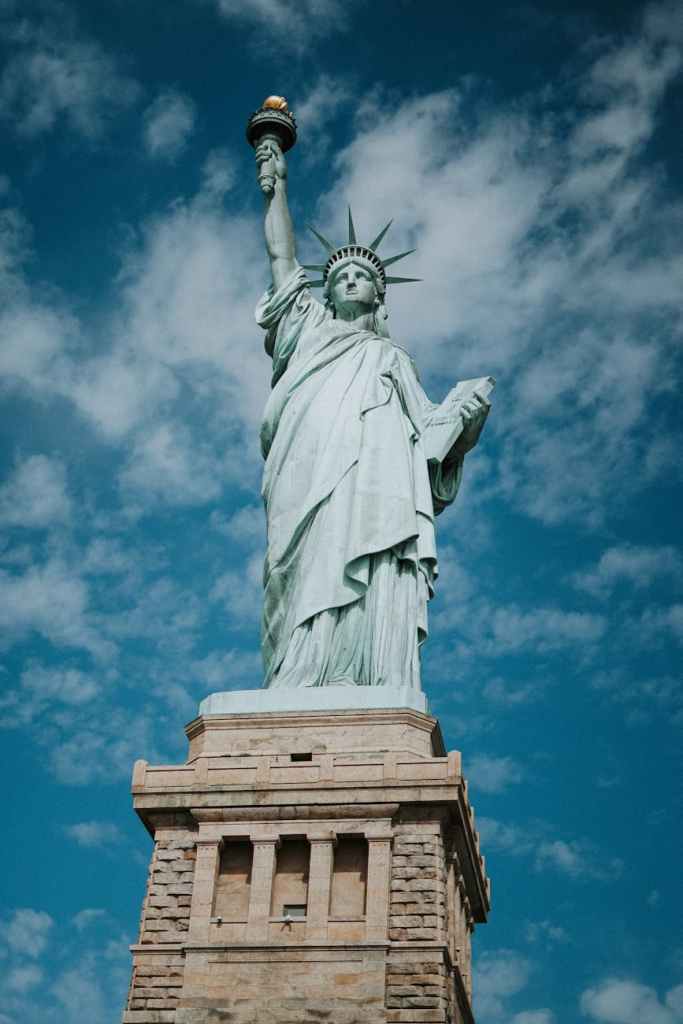
As I sat with all of this—the fear, the loss, the confusion, the escalating responses—my thoughts returned to the Statue of Liberty.
Not just as a monument, but as a promise.
For generations, she has stood as the first glimpse of hope for people fleeing fear, persecution, and silence in search of freedom, rights, truth, and protection. She was never meant to inflame. She was meant to orient.
And I found myself wondering:
If she were given the opportunity to speak today—not to argue or accuse, but simply to remind—what might she say into this moment?
If the Statue of Liberty Could Speak
So I wonder — If Lady Liberty could speak today, not as a symbol to be wielded, but as a witness to what was laid down for this nation — this is what I believe she might say:
I was not raised to inflame you, but to remind you.
I was shaped to stand when tempers rise and fear hardens hearts—not as a weapon, but as a witness.
My torch was never meant to scorch one another.
It was meant to light the way when clarity grows dim.
I have watched generations confuse power with righteousness, volume with virtue, and certainty with wisdom. I have seen freedom invoked without conscience and justice demanded without mercy.
My tablet bears a date, not a slogan.
It records a commitment, not a tribe.
Liberty without responsibility fractures.
Justice without humility corrodes.
Freedom without restraint devours itself.
You ask me where I stand?
I stand where listening precedes judgment.
Where anger does not outrun understanding.
Where the dignity of a human life is not forfeited by disagreement, label, or fear.
I do not ask you to be silent.
I ask you to be measured.
I do not ask you to be passive.
I ask you to be principled.
I do not ask you to agree.
I ask you to remember what you are capable of becoming.
Act justly before you act loudly.
Love mercy before you demand it.
Walk humbly—especially when you believe you are right.
My torch is still raised—not to turn one against the other, but to illuminate the place where conscience still lives
When Life Is Lost, There Is No “Going Back”
There is a truth we have to be willing to sit with.
When life is lost, there is no restoration that gives it back. No explanation that makes it acceptable. No progress that erases the cost.
Some losses change us permanently—as families, as communities, as a nation. Grief without space turns into anger, despair, or numbness.
Honoring the lives that were lost does not mean weaponizing their deaths. It means refusing to let their loss become background noise.
How We Honor the Lives That Were Lost
The best way to honor lives that have been lost is not through volume, outrage, spectacle, or the endless replay of the moment they died.
Those responses may express pain—but they do not preserve dignity. They do not reflect who that person was, the spirit they carried, or what might have been carried forward had that life not been taken.
Lives are honored when we refuse to let their deaths become tools—tools for ideology, escalation, clicks, retaliation, or hardening ourselves against one another.
To honor them requires three difficult things at once:
Truth without distortion.
Restraint after loss.
Memory carried forward as a boundary, not a weapon.
We do not honor the dead by mirroring the forces that harmed them.
We honor them by refusing to let their loss make us abandon conscience.
Before We Respond, We Must Breathe
This is the pause we are missing.
Not denial—but containment.
Not silence—but reflection.
If America does not pause, breathe, and reflect before responding, we may never be the same.
“Those who make peaceful change impossible make violent change inevitable.”
— John F. Kennedy
“In moments of crisis, the most important thing is not to lose your humanity.”
— Viktor Frankl (Holocaust Survivor)
“Justice without mercy is cruelty.”
— Thomas Aquinas
Written with reverence for the lives lost,
with restraint where harm has occurred,
and with the conviction that how we respond now
will shape who we become next.
“What does the Lord require of you?
To act justly, love mercy, and walk humbly.”
— Micah 6:8
— Tina N. Campbell | Scribed in Light


 Scribed In Light
Leave a Reply to wendaswindowcom Cancel reply