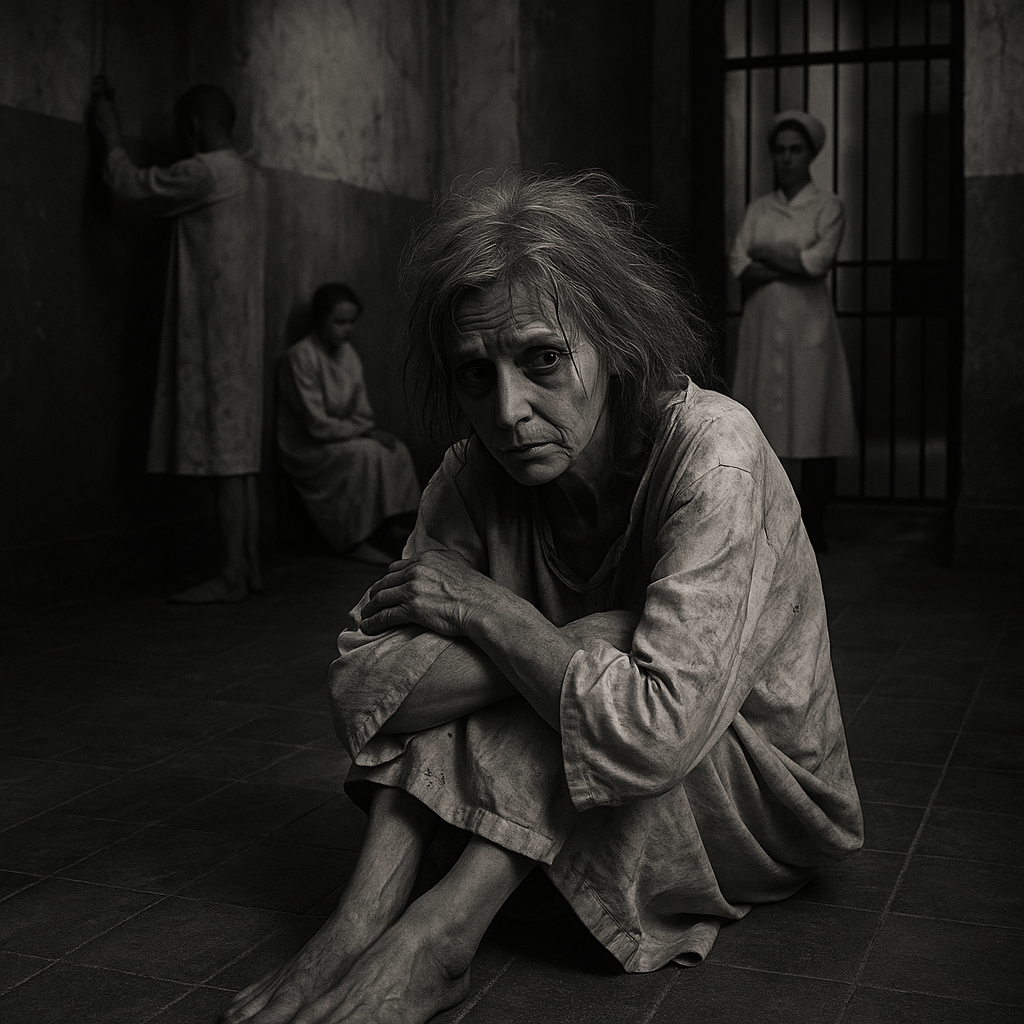
Scrolling recently, I came across a post that said:
“MAKE INSANE ASYLUMS GREAT AGAIN.”
And my whole body went cold.
Because let’s be honest—there was nothing great about asylums. They weren’t centers of healing. They were prisons for the misunderstood. Warehouses of trauma. Graveyards of silenced voices.
And if those places still operated as they once did, I might have been placed in one. My son Austin—with his seizure disorder and intellectual disabilities—might have been locked away. My granddaughter Ezra—with her blindness and autism—could have been erased behind those doors. Not for care, but for convenience.
What “Treatment” Really Meant
When people talk about asylums, here’s what they’re really asking to bring back:
- Chains and cribs: Patients shackled for days, or locked in coffin-like “Utica cribs.”
- Ice water torture: People submerged in freezing baths for hours, or wrapped in wet sheets until their skin cracked.
- Electroshock and insulin comas: Seizures forced daily, bones broken, brains scarred. Insulin overdoses used to induce comas.
- Lobotomies: Ice picks driven through the eyes. Thousands left mute, incontinent, or dead. Women especially targeted—often committed by husbands.
- Forced sterilizations: Thousands stripped of the right to ever have children, simply for being “feebleminded” or “too emotional.”
- Overcrowding & neglect: Institutions packed at double or triple capacity. People lying in filth, starved, beaten, forgotten.
- Sexual abuse: Women and children raped by staff, their cries dismissed as “hallucination.” Pregnancies carried from assaults inside.
- Erasure: Families told to stop visiting. Letters destroyed. Thousands buried nameless under numbered stakes.
Journalist Nellie Bly exposed Blackwell’s Island in 1887 after only ten days inside: beatings, force-feedings, and ice baths. In the 1970s, cameras exposed Willowbrook State School: disabled children naked, rocking in their own waste, used as test subjects.
This is not nostalgia. This is horror.
Survivors’ Voices
I had an elderly friend who lived this truth. His parents, exhausted, placed him in an asylum as a boy. He endured:
- Beatings that broke his spirit.
- Sexual abuse that haunted him for decades.
- Shock treatments delivered like punishment.
- “Experimental therapies” where patients were treated like guinea pigs.
Even in old age, he shook like a leaf when speaking of it. His tears were living proof that trauma doesn’t fade—it brands itself into the body.
And he was one of thousands.
More Forgotten Truths
It wasn’t only the severely ill or violent who were institutionalized.
- People with epilepsy or seizures were locked away simply for having them. Families didn’t understand the condition, and institutions became the default.
- Women with postpartum depression or grief were committed by their husbands or fathers. Some were even sent to doctors who molested them under the guise of “treatment.”
- Anyone who didn’t “fit the norm”—those who were too opinionated, too sexual, too emotional—were labeled “insane” and warehoused.
As my daughter Alyssa said:
“Most people who spew this don’t even understand the weight it holds. They’re just following blindly. Even people with seizures were put in those places just for having seizures. And women who were depressed were sent to be molested by doctors as ‘treatment.’ It’s back in the day for a reason—it was abuse, not care.”
The Present Echo
Some people argue, “We’d do it differently this time. We’d make it better.” But look around.
- Our nursing homes are already understaffed and undertrained. Abuse and neglect happen because aides are stretched thin and doctors often practice hallway medicine—assessing charts without ever stepping into a room.
- We’ve already watched as immigrant families and children were packed into detention centers without enough food, water, beds, or blankets. People cried out in anger at the inhumanity—and rightfully so. It looked like history repeating itself.
- And in that climate, the idea of “asylums” starts to sound like a solution. Just one baby step. Just one “necessary measure.” Just one more way for governments to “take control.”
But here’s the truth: innocents will suffer first. The vulnerable will pay the price. Not just the violent, not just the unstable, but the misunderstood, the disabled, the inconvenient.
If we don’t have the resources, training, or compassion to properly staff nursing homes, how could we ever expect new asylums to be humane? They wouldn’t. They would repeat the same horrors of the past.
Today’s Reality: The First Steps Backward
This isn’t a distant fear—it’s already happening.
- The federal government recently dismantled the Administration for Community Living, cutting vital disability and aging supports like independent living centers and respite care.
- Day habilitation programs in Massachusetts have shut their doors, leaving over 1,000 people without support.
- In Texas, 14 group homes closed in a single sweep, displacing nearly 50 residents.
- Missouri voted to close 12 schools for severely disabled children by 2026.
These aren’t relics of the past. These are the cracks forming right now in the foundation of care. And into those cracks, people will fall.
The entitled, the naive, the uneducated, the inexperienced voices cheering “make asylums great again” don’t see the bigger picture: when community supports collapse, institutions rise in their place. And history has already shown us what that means—chains, cages, and silence.
The Convenience of Cruelty
To say “Make asylums great again” is no different than saying, “Let’s bring back the Holocaust—it was convenient.”
It’s the same mindset: gather up the people society finds “inconvenient,” strip them of rights, and lock them away behind closed doors. The disabled. The traumatized. The outcast. The misunderstood. Hide them from view, call it “care,” and pretend it makes the world more orderly.
That isn’t care. That’s cruelty disguised as convenience.
The Lie of Innocence
People defend these posts or sermons by saying, “It’s just a joke,” or, “It’s just tradition.” But it’s never innocent.
These posts are anything but innocent. They are seeds. Seeds of stigma. Seeds of regression. Seeds of cruelty dressed up as comedy. And when we let those seeds take root—when we laugh, scroll, or stay silent—they grow into the same horrors our ancestors fought to end.
Oppression doesn’t start with an explosion—it starts with a whisper. With a meme. With a sermon. With silence.
A Frightening Echo in Real-Time
This isn’t just a debate about history. It’s happening now. Recent executive orders and political platforms are already moving toward reopening institutional-style psychiatric hospitals and expanding forced hospitalization under the banner of mental health care.
And who will be swept up first? The homeless.
And among them, a disproportionate number are veterans—men and women who once served their country, now living with wounds both visible and invisible. PTSD, traumatic brain injuries, and service-related disabilities have left many without stability.
Instead of care, they risk being rounded up and warehoused. Branded as dangerous, inconvenient, or unstable. The same cycle, dressed in new language.
When Power Meets Incompetence
And let’s not kid ourselves—if asylums were revived today, the government wouldn’t hand them over to the most compassionate caregivers. History shows us it’s always been the opposite.
They would hand power to whoever promised “efficiency.” To unqualified figures with money, influence, or ego—people playing with lives like dice on a table. Just as untrained doctors once wielded ice picks and called it medicine, so too could tomorrow’s unqualified leaders weaponize people’s suffering under the guise of “order.”
And the government would push its own narrative, just as it always has: telling us this is for “safety,” for “progress,” for “control.” But beneath that veneer is the same truth it’s always been—innocents would pay the price first.
The Way Forward: Real Solutions
We don’t need more cages. We need more care.
- Community-Based Mental Health Care
- Local clinics, crisis teams, affordable meds and therapy.
- Specialized Training for Staff
- Real psychiatric and trauma-informed training for nurse aides, RNs, and caregivers.
- Support for Families
- Respite programs, in-home trained care, caregiver stipends.
- Oversight & Accountability
- Surprise inspections, cameras in common spaces, whistleblower protections.
- Change the Narrative
- Teach mental health in schools.
- Normalize early intervention.
- End the shame of neurodivergence.
My Stand
There was nothing “great” about asylums. They were horror disguised as medicine.
If we bring them back, it won’t just be the violent or unstable locked away. It will be kids like Austin. Grandchildren like Ezra. Women who speak too loudly. Men who don’t fit the mold. People who simply need care, but whose families are tired, overwhelmed, or untrained.
Yes, our system today is broken. But the answer is not to go back. The answer is to go forward—with dignity, accountability, and care.
I refuse to let “innocent” words resurrect chains. I refuse to let history’s horrors be romanticized. Because silence is what allowed the abuse then. And silence now will only guarantee we repeat it.
As Proverbs 31:8–9 commands: “Speak up for those who cannot speak for themselves, for the rights of all who are destitute. Speak up and judge fairly; defend the rights of the poor and needy.”
Martin Luther King, Jr. warned us: “Injustice anywhere is a threat to justice everywhere.”
Jimmy Carter reminded us: “The measure of a society is found in how it treats its weakest and most helpless citizens.”
And Thomas Jefferson declared: “All tyranny needs to gain a foothold is for people of good conscience to remain silent.”
So I will not be silent. Not now. Not ever.
Survivor Testimonies: The Hidden Truth Behind “Treatment”
Nellie Bly, journalist who went undercover in Blackwell’s Island Asylum (1887):
“What, excepting torture, would produce insanity quicker than this treatment? … Take a perfectly sane and healthy woman, shut her up, and make her sit from 6 a.m. until 8 p.m. on straight-back benches, do not allow her to talk or move, and the result will be insanity.”
Willowbrook State School (1972 TV exposé, New York)—Geraldo Rivera described:
“Children lay naked on the floor. Some smeared with their own feces. Many were left unattended, rocking back and forth in filth. The stench was overwhelming. They were warehoused like animals, not cared for as children.”
Rosemary Kennedy (sister of President John F. Kennedy), lobotomized at age 23 by Dr. Walter Freeman (1941):
After the surgery, she was left permanently incapacitated, unable to speak or care for herself. Her “condition”? Mood swings and being “difficult” for her father.
A survivor of insulin shock therapy recalled:
“We would wake up covered in urine and vomit, not knowing our own names. They told us it was treatment, but it felt like punishment for being alive.”
Testimony from the 1940s Pennsylvania asylum investigations:
“Patients were found in cages, naked, covered in sores. They cried like children, begging not to be left alone, but they were ignored. The attendants laughed.”
My intention is not to harm, but to awaken. To remind us that what was once called “care” was too often cruelty, and that we have a choice to do differently now. We cannot change the horrors of yesterday, but we can build tomorrow with justice, mercy, and dignity.
This is not about dragging us backward—it’s about calling us forward. Toward a future where dignity replaces chains, where care replaces cruelty, and where love silences fear. I believe we can build that world. But it starts with truth—and with us refusing to stay silent.
Lord, awaken our hearts to remember the lessons of history. Give us eyes to see injustice for what it is, courage to speak for those who cannot, and compassion that chooses care over cruelty. Protect the vulnerable, strengthen the weary, and guide us to build a future where dignity, mercy, and justice prevail. May we never be silent in the face of suffering, but be voices of truth, healing, and hope. In Jesus’ name, Amen.
Tina N. Campbell | Scribed in Light


 Scribed In Light
Leave a Reply to Herald Staff Cancel reply